
In a late-night tweet in capital letters, he said Iran must 'never, ever threaten the United States again'.

"It is time to recognise that nuclear power is not a clean, safe or affordable source of energy," said the letter written by nine laureates including Archbishop Desmond Tutu, Adolfo Perez Esquivel and Jose Ramos Horta.

If international crude oil prices zoom past the current level of about $90 per barrel and move towards $100 and beyond, middle-class consumers are not going to keep quiet about their discomfort, points out Arun Balakrishnan, former chairman and managing director, Hindustan Petroleum.

He said the US will apply other punitive measures if Tehran does not give up its reported goal of developing nuclear weapons.

Smart windows are aimed at saving on cooling and heating bills for homes and businesses.

The analysis of this data that could lead to the discovery of the Higgs boson, also called as the 'God particle', that is believed to have existed when the universe was born, said Prof Satyaki Bhattacharya of Delhi University who is involved in the LHC experiment.

BWith a distracted president brooding in the White House, Pompeo seems to think his day has come. He seems to be pushing a personal agenda before a target audience in America, observes Ambassador M K Bhadrakumar.

Notwithstanding the NSG waiver for New Delhi, Japan on Wednesday appeared non-committal on civil nuclear cooperation with India even as the two countries agreed that atomic power could play an important role as a sustainable and non-polluting source of energy in meeting the growing global demands.
Notwithstanding the Nuclear Suppliers Group waiver for New Delhi, Japan on Wednesday appeared non-committal on civil nuclear cooperation with India even as the two countries agreed that atomic power could play an important role as a sustainable and non-polluting source of energy in meeting the growing global demands
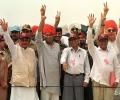
'1998-1999 was the only year in the last quarter century that India had net-negative foreign investment.' 'Foreign money ran away from India that year because capital is a coward and does not like uncertainty of the sort produced by such casual treatment of a destructive technology,' says Aakar Patel.
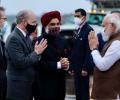
Prime Minister Narendra Modi on Thursday is scheduled to have as many as eight meetings, including with Vice President Kamala Harris, on the first working day of his current US trip.

Leaders of the two countries, however, did discuss on Pakistan's nuclear safety and security which is an ongoing discussion.

In addition to helping scientists answer fundamental questions about the nature of matter, the material is theorised to have a wide range of applications, including as a room-temperature superconductor.
Keeping in view the ever-increasing energy requirement, India is all set to establish at least four nuclear reactors besides the world's first thorium-based reactor by 2020.
"The enemies of the country want to project the militancy in the country as indigenous and for this purpose, they have been recruiting some local youth for arms training," he said.

Dr Ajay Kumar Sood will have to complete a task his predecessor started: Getting the government to sign off on a new Science, Technology, and Innovation Policy on which work was begun in 2020.
"The reason for the fire accident, as indicated by the report of Investigation Committee set up by BARC, is low intensity explosive energy released from accidental mixing of small quantities of reactive chemicals stored in the Chemical Laboratory," Minister of State in PMO Prithviraj Chavan said in a written reply in the Lok Sabha on Wednesday.
"In our dialogue with the Pakistani government, we have clearly said we will work with them on civil nuclear energy," Clinton told a group of Pakistani journalists in Islamabad on July 19, according to the transcripts made available by the State Department.
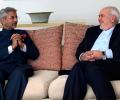
'Tehran,' Foreign Minister Zarif said, 'had expected the Modi government to be "more resilient" in the face of Washington's bullying,' notes Ambassador M K Bhadrakumar.

The landmark civil nuclear deal sealed on Friday with Japan is strikingly similar to the agreements India has with the US and some other countries but contains some added features on safety and security, reflecting Japan's concerns on the issue.

Informing the world leaders of measures taken by him, Modi said India will continue to accord a high national priority to nuclear security through strong institutional framework, independent regulatory agency and trained and specialised manpower.
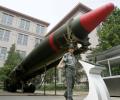
Despite four disarmament section talks and six strategic dialogues between the two foreign ministries, China's intransigence on recognising Indian nuclear status resulted in no confidence building measures in the nuclear field between the two, says Srikanth Kondapalli.
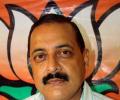
Word from the BJP is that following the controversy over his comments on Article 370, Jitendra Singh has been asked to desist from talking about his favourite topics and focus instead on the business of governance and the sizeable portfolios that he has been entrusted with, writes Archis Mohan.

National Aeronautics and Space Administration's Mars rover Curiosity has made the first definitive detection of organic molecules, the building blocks of all known forms of terrestrial life, on the surface of the Red Planet.

The reversal of Trump's policy with regard to Iran, like the withdrawal from the Paris Agreement, may not be a matter of just turning the clock back, but one of patient negotiations, with uncertain consequences in the post-COVID-19 world, observes Ambassador T P Sreenivasan.
Hundreds of anti-nuclear activists and leaders of different political outfits were detained in Chennai on Monday when they attempted to lay siege to the Tamil Nadu assembly demanding scrapping of the Kudankulam Nuclear Power Plant. S Saraswathi reports.

Prime Minister Manmohan Singh on Friday batted for nuclear power as a "dependable and clean option", even as he underlined the need to ensure that all ingredients by which nuclear fuel is made remain safe and do not fall in the hands of terrorists and anti-social elements.
India's first 1000 MW atomic power plant built with Russian collaboration at Kudankulam is just two steps away from going critical, a top official said on Friday.

Taking a leaf from 'Jal Satyagraha' activists in Madhya Pradesh, the activists of People's Movement Against Nuclear Energy stood in the waters close to the shores in a new turn to their year-long protests.
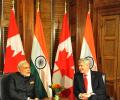
Canada will supply uranium to energy-starved India beginning this year over a period of five years, a decision which was termed as a launch of a new era of bilateral cooperation and mutual trust by Prime Minister Narendra Modi.

'It was India's good fortune to have a Vajpayee lead the government at this crucial moment in history.' 'By taking the N-decision he saved future generations of Indians from being 'Kosovoed' or 'Iraqed',' says Colonel Anil A Athale (retd).

The LIGO announcement -- which confirmed, among other things, that gold, platinum and other heavy metals were products of neutron star collisions -- came just before Subrahmanyan Chandrasekhar's 107th birthday.
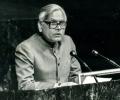
On her 101st birth anniversary, November 19, four letters that reveal a different side to inarguably India's toughest prime minister.

'The biggest lacuna in this agreement is it is called 'full civil nuclear cooperation agreement.' Actually, it is anything but full.'
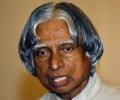
India plans to produce about 20,000 mega watt of nuclear power keeping safety features in mind, former President A P J Abdul Kalam on Friday said as he certified the Kudankulam atomic plant as safe.
Strongly favouring nuclear power, Prime Minister Manmohan Singh on Wednesday said there would be no compromise on safety of atomic plants and it would be harmful to close the additional source of energy.
Pak approaches NSG for a nuclear deal similar to the US-India one
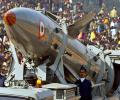
The 'Make in India' concept in the defence sector has the potential to help India meet 70 per cent of its defence needs in a few years.
India's Civil Nuclear Liability Bill will not have an immediate adverse impact on Indo-Russian cooperation in atomic power generation, but Russian contractors would not like to see safety issues raise their project costs. Director for the Centre of Energy and Security Studies and Editor-in-Chief of the Nuclear Club magazine Anton Khlopkov said the legislation passed by the Indian Parliament "is raising concerns in Russia".

'The unique achievements have been made by engineers from small towns who have had a non elite upbringing and who have grown with the programme,' says R Aravamudan, one of the pioneers of the Indian space programme.
